
Vermont Estate & Gift Tax Planning
Keep More of What You Built — For the People You Love
Regardless of which estate planning documents you decide on, all individuals with larger estates need to understand the federal and Vermont estate and gift taxes — and how both taxes may apply to their estates. At Nicole Peck McPhee, PC, we help Vermont families and business owners understand exactly what they owe, what they do not have to pay, and how to structure their estates to keep as much as possible out of the government's hands and in their families' hands.
|
2026 Estate & Gift Tax: Key Numbers at a Glance ✦ Federal Unified Credit (2026) — $15,000,000 per person — permanently set by the One Big Beautiful Bill Act (P.L. 119-21), signed July 4, 2025. Inflation-indexed from 2027. ✦ Married Couple Combined — Up to $30,000,000 sheltered from federal estate tax — if portability is properly elected on the first spouse's estate tax return ✦ Federal Estate Tax Rate — Up to 40% on taxable amounts above the unified credit ✦ Vermont Estate Tax — 16% flat rate on all assets over $5,000,000 (Vermont § 7442a) — separate from and in addition to federal estate tax ✦ Annual Gift Tax Exclusion (2026) — $19,000 per recipient per year; $38,000 per recipient for married couples combining exclusions ✦ Medical & Educational Gifts — Amounts paid directly to a qualified provider for medical or educational expenses are not subject to gift tax — regardless of amount |
The Gift Tax and the Estate Tax — How They Work in Vermont
The Gift Tax
The gift tax applies to all transfers of property made during a person's lifetime — whether given outright or in trust. These are called inter vivos gifts. Unless an exception applies, the gift tax must be paid on all inter vivos gifts that exceed the annual exclusion and the unified credit.
The Estate Tax
The estate tax applies to all transfers of property that take effect at death — whether by will, by trust, or by operation of law. These are called testamentary gifts. When you die, your gross estate includes personal property such as vehicles and computers, liquid assets such as savings accounts and investment funds, real estate, retirement accounts, and life insurance proceeds. Life insurance proceeds are included in the gross estate for estate tax purposes even though they are not taxable income to the recipient.
Your Taxable Estate
Your taxable estate equals your gross estate minus allowable deductions: funeral and burial expenses paid from the estate, debts owed at death, the value of property transferred to a U.S. citizen spouse (the unlimited marital deduction), the value of property transferred to a qualifying charity, and state death taxes paid.
The Unlimited Marital Deduction
Under federal tax law, one spouse can transfer an unlimited amount of property to a U.S. citizen spouse — during their lifetime or at death — with no federal estate or gift tax consequence. This is called the Unlimited Marital Deduction. The estate tax can be completely avoided at the first spouse's death simply by leaving everything to the surviving spouse.
|
The Critical Limitation: Upon the death of the surviving spouse, the unlimited marital deduction is no longer available. All assets in the surviving spouse's estate are now exposed to estate tax. Transfers to other loved ones — children, grandchildren, other family members — are protected only by the unified credit. This is why simply leaving everything to your spouse is rarely the most tax-efficient plan for larger Vermont estates. |
The Unified Credit — Your Most Powerful Estate Tax Shield
The unified credit is a credit against the gift or estate tax that would otherwise be owed. In 2026, this credit is $15,000,000 per person — permanently set at that level by the One Big Beautiful Bill Act (P.L. 119-21), signed into law on July 4, 2025. The first $15,000,000 of each person's estate is completely shielded from federal estate tax.
If an estate exceeds $15,000,000, federal estate tax is owed on the excess at rates up to 40%. Because the federal exemption is portable between spouses, a married couple can combine their unified credits to shelter up to $30,000,000 from federal estate tax — provided the portability election is timely made on the first spouse's federal estate tax return.
In addition to the federal estate tax, Vermont assesses its own estate tax at a 16% flat rate on all assets over $5,000,000 (Vermont § 7442a). Vermont's threshold is entirely separate from the federal exemption — meaning a Vermont estate that falls below the federal threshold may still owe Vermont estate tax.
Annual Gift Tax Exclusion — Reducing Your Vermont Estate Over Time
One way to reduce your taxable estate is to give property away during your lifetime, bringing your estate below the applicable tax threshold. However, the tax code strictly limits nontaxable gifts. Gifts beyond these limits are subject to the gift tax once the unified credit is exhausted.
|
2026 Annual Gift Tax Exclusion Rules ✦ Per-Recipient Annual Exclusion — $19,000 per individual per year — any person can give any number of recipients up to $19,000 each without gift tax ✦ Married Couple Gift-Splitting — Spouses can combine exclusions and give $38,000 per recipient per year, gift-tax-free ✦ Direct Medical Payments — Any amount paid directly to a medical provider for another person's medical expenses is not subject to gift tax ✦ Direct Educational Payments — Any amount paid directly to a qualified educational institution for tuition is not subject to gift tax ✦ 529 College Savings Plans — Contributions to 529 plans may qualify for gift tax exclusion treatment in certain circumstances ✦ Gifts in Trust (Crummey Powers) — Annual exclusion gifts can be made in trust only if the trust includes specific demand rights (Crummey powers) granting beneficiaries the right to withdraw contributions |
The Credit Shelter Trust — Using Both Spouses' Unified Credits
The most powerful estate tax-avoidance mechanism for a married couple is ensuring that both spouses' full unified credits are utilized. There are two ways to accomplish this.
The first option — simply leaving an amount up to the unified credit directly to children or a third party at the first death — eliminates the estate tax problem but leaves the surviving spouse without access to those assets.
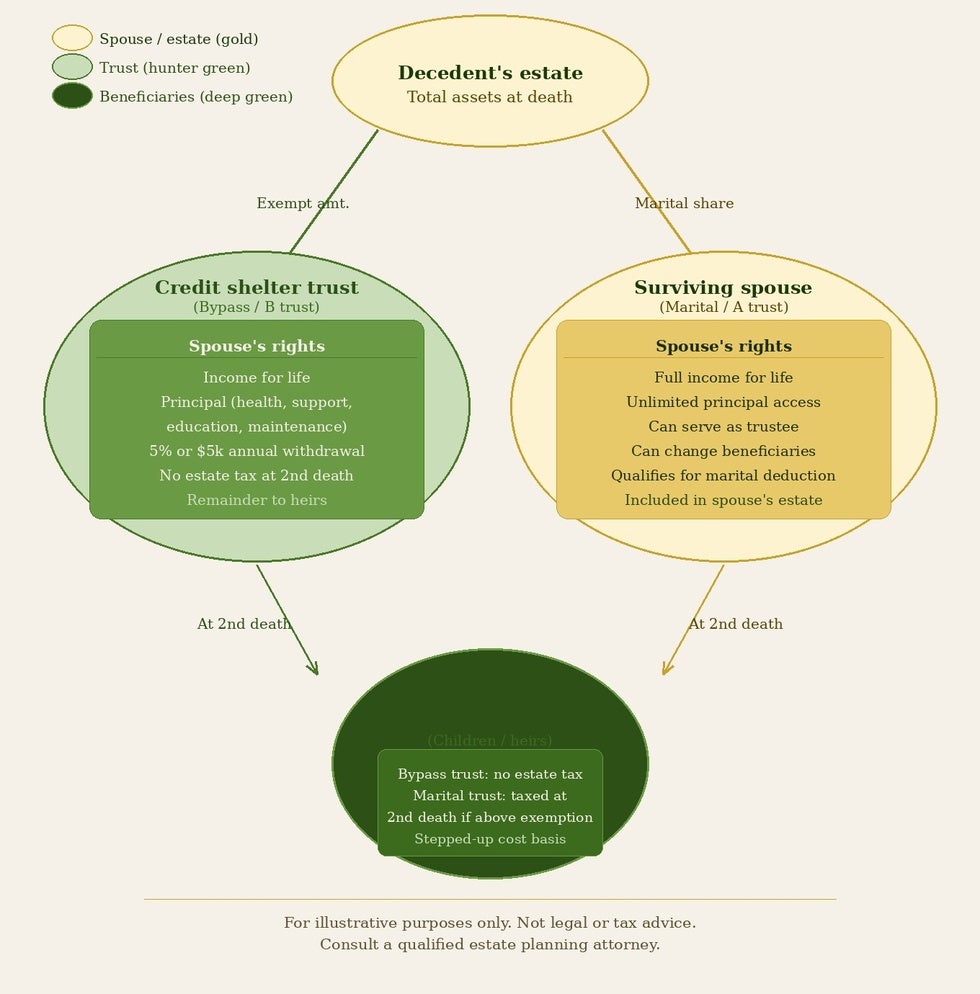
The second and more common option is the Credit Shelter Trust, sometimes called a Bypass Trust or A/B Trust. The first spouse's estate leaves the unified credit amount in trust for the benefit of the children, with the surviving spouse receiving income and limited access to principal during their lifetime. The remaining assets pass outright to the surviving spouse, sheltered by the unlimited marital deduction. When the surviving spouse dies, both the trust assets and their own estate are fully sheltered by both spouses' unified credits.
The Power of Joint Credits: Two Examples
|
EXAMPLE 1 — No Tax Planning |
EXAMPLE 2 — Credit Shelter Trust |
|
|
Husband (H) dies in 2026 Estate: $16,000,000 |
Husband (H) dies in 2026 Estate: $16,000,000 |
|
|
▼ |
▼ |
|
|
100% to Wife — unlimited marital deduction |
$15,000,000 → Credit Shelter Trust $1,000,000 → to Wife outright |
|
|
▼ |
▼ |
|
|
Wife now owns: $16M + $14M = $30,000,000 |
Trust shielded by H's $15M credit W's estate: $1M + $14M = $15M |
|
|
▼ |
▼ |
|
|
Wife dies Taxable estate: $30,000,000 |
Wife dies W's estate: $15,000,000 |
|
|
▼ |
▼ |
|
|
W's $15M credit shelters: $15,000,000 → tax-free $15,000,000 → EXPOSED to tax |
W's $15M credit covers her estate: $15,000,000 → NO TAX Trust assets also pass tax-free |
|
|
▼ |
▼ |
|
|
FEDERAL ESTATE TAX OWED ≈ $4,800,000 – $6,000,000+ H's $15M credit — WASTED |
TOTAL FEDERAL ESTATE TAX $0 $30,000,000 to children — TAX-FREE Both H & W credits fully used |
2026 figures reflect the One Big Beautiful Bill Act (OBBBA, P.L. 119-21, signed July 4, 2025). Federal unified credit: $15,000,000 per person, permanent and inflation-indexed from 2027. Vermont estate tax (§ 7442a): $5,000,000 threshold, 16% flat rate — separate from federal. Not legal or tax advice. Consult a licensed Vermont attorney.
Illustration of how a credit shelter trust works
Advanced Vermont Estate Tax Planning Tools
For unmarried individuals and married couples with estates larger than both unified credits, several additional strategies are available to reduce or eliminate estate tax exposure. Attorney Nicole Peck McPhee helps Vermont clients evaluate and implement each of these approaches as part of a comprehensive estate plan.
Charitable Planning Trusts
✦ Charitable Remainder Trust (CRT) — A tax-exempt irrevocable trust that provides income to the grantor or other designated beneficiaries for a specified period. The remaining assets ultimately pass to one or more charitable organizations — reducing the taxable estate while generating income.
✦
✦ Charitable Lead Trust (CLT) — An irrevocable trust that provides income payments to one or more charities for a specified period. The remaining assets eventually pass to non-charitable beneficiaries such as family members or designated heirs.
Grantor Trust Strategies
✦ Intentionally Defective Grantor Trust (IDGT) — Removes assets from the grantor's estate for estate tax purposes while keeping income taxable to the grantor. The grantor can gift or sell assets to the trust, and any appreciation grows tax-free inside the trust. The grantor's payment of income tax is not treated as an additional taxable gift — effectively making a tax-free wealth transfer to the beneficiaries.
✦ Spousal Limited Access Trust (SLAT) — Allows one spouse (the donor spouse) to transfer assets into an irrevocable trust for the benefit of the other spouse and potentially other family members, while still maintaining some indirect access to the assets. SLATs are widely used to leverage estate tax exemptions before they change.
Life Insurance and Residence Trusts
✦ Irrevocable Life Insurance Trust (ILIT) — Holds a life insurance policy outside the grantor's taxable estate, providing liquidity at death to pay estate taxes, fund buyouts of Vermont family business interests, or provide for family members — without the proceeds being added to the taxable estate.
✦ Qualified Personal Residence Trust (QPRT) — The grantor transfers a Vermont home or vacation property into an irrevocable trust while retaining the right to live there for a set term. At the end of the term, the property passes to the named beneficiaries at a reduced gift tax cost. Any appreciation after the transfer grows completely tax-free.
Annuity and Generation-Skipping Strategies
✦ Grantor Retained Annuity Trust (GRAT) — Transfers appreciating assets out of the grantor's taxable estate without using any portion of the unified credit. The grantor retains an annuity payment for a specified term; any growth above the IRS hurdle rate passes to heirs tax-free.
✦ Generation-Skipping Transfer Trust (GST Trust) — Designed to pass wealth to grandchildren or later generations while minimizing or avoiding the generation-skipping transfer tax — one of the most powerful tools for multi-generational Vermont family wealth planning.
✦ Credit Shelter / Bypass Trust — Ensures both spouses' unified credits are fully utilized, as illustrated in the examples above. Can be structured as a QTIP trust depending on the grantor's goals for spousal access and ultimate distribution.
Entity-Based Valuation Discount Strategies
✦ Family Limited Partnership (FLP) — A legal entity created by family members to hold and manage assets collectively. Because of the transfer restrictions placed on limited partnership interests, the IRS allows valuation discounts — allowing a general partner to gift or sell discounted limited partnership interests to junior family members over time, leveraging annual exclusions and the lifetime exemption.
✦ Limited Liability Company (LLC) — Combines limited liability protection with pass-through taxation. Like FLPs, LLCs can offer valuation discounts on transferred membership interests due to transfer restrictions — allowing incremental, tax-efficient transfers to the next generation while the original owner retains management control.
✦ Corporation — A separate legal entity with limited liability for shareholders. Corporations can own property, enter contracts, and conduct business operations. Corporate structures may provide estate planning opportunities through recapitalization, buy-sell agreements, and strategic ownership arrangements.
Vermont Estate Tax Planning — Statewide Service
Attorney Nicole Peck McPhee serves Vermont individuals, families, and business owners throughout the state on estate and gift tax planning matters. In-person meetings are available at our Rutland, Vermont office. Virtual consultations via Zoom or Google Meet are available statewide — including Rutland, Bennington, Middlebury, Ludlow, Springfield, Woodstock, and all communities throughout Vermont.
Schedule a Consultation with Attorney Nicole Peck McPhee
Whether for estate planning and wills or trusts, a real estate transaction, business formation or acquisition, or a private adoption matter, the first step is a focused one-on-one consultation. Nicole will learn about your situation, clearly explain your legal options, and outline exactly what is needed and at what cost. Consultations are available in person in Rutland or by secure Google Meet for clients anywhere in Vermont.
Contact us at 802-775-4845 or by email at [email protected] or contact Nicole Peck McPhee, PC.